
It is one of the most frustrating ironies in sports medicine: tennis elbow (lateral elbow tendinopathy) is frequently seen in people who have never picked up a racket in their lives.
If you spend your weekends working on your handicap or fine-tuning your game, you are far more likely to experience this nagging pain on the outside of your forearm.
When your lead arm clears through impact, any hitch in the kinetic chain can put immense pressure right on the bone. If you are currently fighting that familiar, sharp ache during your release, understanding exactly what you are dealing with—and how to accurately manage it—is the first step back to a pain-free swing.
—————————————————————————————
What Exactly is "Tennis Elbow"?
Medically termed lateral elbow tendinopathy (and historically known as lateral epicondylitis), tennis elbow is a clinical presentation of overload. It affects the common extensor tendon, primarily the extensor carpi radialis brevis (ECRB), which attaches to the bony bump on the outside of your elbow (the lateral epicondyle).
Despite the "-itis" suffix often thrown around, it is rarely a case of acute inflammation. Instead, it is a micro-tearing and degenerative failing of the collagen fibers within the tendon. When the mechanical demand placed on the wrist extensors—usually from repetitive gripping, wrist extension, or resisting forceful rotation—exceeds the tendon's structural capacity, it begins to protest.
Telling It Apart: How to Identify Your Elbow Pain
Elbow pain can be deceptive. Because the joint is a crossroads for multiple muscle groups and major nerves, proper differentiation is vital before starting any treatment plan. If you are trying to figure out exactly what is causing your symptoms, look closely at where the pain is localized and what triggers it:
1. Tennis Elbow (Lateral Tendinopathy)
Primary Pain Location: The outside of the elbow, centered directly on or around the prominent bony bump (the lateral epicondyle).
Key Aggravating Factors: Gripping firmly, lifting objects with your palms facing down, or hitting the ball during the impact phase of your golf swing.
Clinical Presentation: Distinct, localized tenderness when pressing directly on the outside elbow bone, alongside pain or weakness when trying to extend your wrist against resistance.
2. Golfer’s Elbow (Medial Tendinopathy)
Primary Pain Location: The inside of the elbow, centered on the inner bony bump (the medial epicondyle).
Key Aggravating Factors: Loading your trail arm during the swing, heavy or repetitive wrist flexion, and hitting "fat" shots that take a heavy divot.
Clinical Presentation: Deep tenderness on the inner elbow bump; pain is sharply reproduced when flexing the wrist downward or forcefully "casting" the club.
3. Radial Tunnel Syndrome
Primary Pain Location: The fleshy muscle belly of the upper forearm, typically about two inches below the actual elbow joint line.
Key Aggravating Factors: Repetitive twisting motions of the forearm, such as turning doorknobs, using screwdrivers, or rapidly supinating and pronating during a swing.
Clinical Presentation: Frequently misdiagnosed as tennis elbow, but it is actually a nerve compression. It causes a deep, fatigue-like aching in the forearm muscles, and the bony epicondyle itself is rarely tender to the touch.
4. Cervical Radiculopathy
Primary Pain Location: Diffuse, poorly localized pain that feels like it radiates or shoots down the entire length of the arm.
Key Aggravating Factors: Moving your neck into specific positions, looking upward, or holding sustained typing and driving postures.
Clinical Presentation: The root cause originates in the neck (typically compression of the C6 nerve root). It is almost always accompanied by secondary neurological symptoms, such as numbness, a "pins and needles" tingling sensation, or localized muscle weakness further down the arm.
How We Treat It: A Progressive, Load-Modified Approach
Passive treatments like ice, rest, or generic stretching might offer temporary relief, but they do not alter the structural integrity of a failing tendon. To build long-term resilience, a structured, active rehabilitation program is essential.
1. Relative Load Management & Offloading
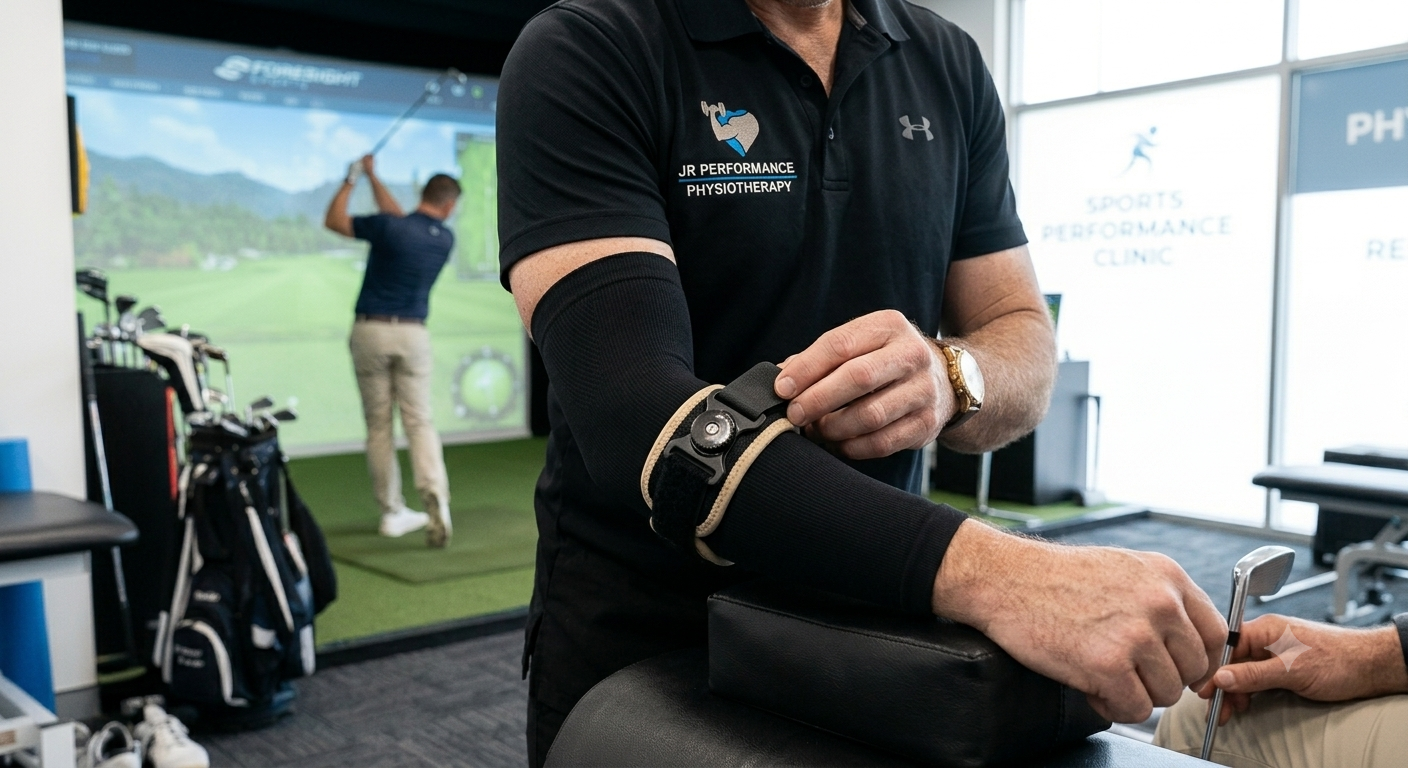
Complete rest causes a tendon to lose even more capacity. Instead, we modify your volume. This is where a targeted tennis elbow clasp brace can be an invaluable short-term tool. By applying precise, circumferential pressure over the muscle belly just below the elbow, the clasp mechanically alters the angle of pull, effectively creating a "new" temporary attachment point and reducing the direct tensile stress on the healing tendon.
2. Targeted Structural Loading
The gold standard of tendinopathy management centers around progressive resistance. We transition through explicit stages:
• Isometrics: Sustained, non-moving wrist extension holds to induce an analgesic (pain-relieving) effect.
• Isotonics: Slow, controlled eccentric (lowering) and concentric (raising) lifting to stimulate proper collagen remodeling.
3. Kinetic Chain and Biomechanical Assessment
True resolution requires looking away from the elbow. If you lack thoracic rotation or shoulder mobility, your forearm muscles are forced to overcompensate to square the clubface at impact.
Based in Cheshire or North Wales and ready to stop guessing? Operating right out of the Pro Sim Golf facility in Chester, JR Performance Physio combines elite musculoskeletal diagnostic skills with Titleist Performance Institute (TPI) medical screenings. If you want an expert structural analysis of your upper limb mechanics on the simulator, you can book a Golf Physiotherapy Assessment at our Chester Clinic to pinpoint the exact root cause of your pain.
—————————————————————————————-
Prognosis: Can You Keep Playing Golf in Cheshire?
The short answer is yes, but with a caveat: strategy trumps stubbornness.
Tendons heal slowly due to their naturally limited blood supply. A typical recovery timeline for an established lateral tendinopathy ranges from 6 weeks to several months, depending on how long the symptoms have been present.
However, you rarely need to abandon the game entirely. If your pain levels remain low (below a 3/10 on a pain scale) and settle within 24 hours of practicing your swing, modified loading is often highly beneficial. While you recover, consider a quick trip to a local professional club fitter around Chester or the Wirral to explore a few mechanical adjustments:
• Thicken Your Grips: Moving to midsize or jumbo grips reduces the amount of baseline finger-flexion and gripping force required to control the club.
• Switch to Graphite Shafts: Graphite dampens vibrations significantly better than steel, sparing your extensor tendon from harsh shockwaves at impact.
• Shorten the Swing: Avoid an overly aggressive "casting" motion on the downswing, which puts immense eccentric strain on the lead wrist extensors.
If you are tired of modifying your swing around pain and want a structured roadmap back to peak performance, taking action early prevents a minor strain from becoming a chronic issue. Schedule your TPI Movement Screen and Clinical Consultation today at our Chester clinic to get a definitive diagnosis, a bespoke loading program, and a professional strategy to keep you on the course.